The FAIR LA Plan
[et_pb_section fb_built="1" _builder_version="3.22.3"][et_pb_row _builder_version="3.22.3" background_size="initial" background_position="top_left" background_repeat="repeat"][et_pb_column type="4_4" _builder_version="3.0.47"][et_pb_text _builder_version="3.22.7" background_size="initial" background_position="top_left" background_repeat="repeat"]

Get ready: by the end of the decade, Los Angeles might build over 450,000 new homes.
This might surprise many readers. Have YIMBYs hypnotized the L.A. City Council? Not quite. Every eight years, cities are required under state law to update their housing elements, a planning document that assesses a city’s housing needs and sets a strategy for accommodating new housing at all income levels.
Historically, many cities found ways to avoid creating housing elements that would actually lead to more homebuilding. But ahead of this housing element cycle, which starts in 2021, new laws were passed to beef up compliance and enforcement.
Thanks to your advocacy, the state gave Southern California a historically high goal of over 1.3 million homes, and local officials allocated most of that target to coastal cities with good access to jobs and transit. In particular, Los Angeles was assigned a target of 456,000 new homes, which, if achieved, would increase the housing supply by 30%.
Now, cities across Southern California are beginning work on their housing elements. Abundant Housing is proud to be serving on L.A.’s housing element task force, alongside more than 60 other community stakeholders.
We’re committed to supporting a housing element plan that equitably achieves L.A.’s housing production target. A few months ago, we shared policy ideas for the housing element that we think will improve affordability, environmental quality, and transit access throughout L.A.
One of the first steps towards that goal will be deciding how to allocate housing targets across L.A.’s neighborhoods. Abundant Housing recommends allocating most of the housing target to wealthy, high-opportunity neighborhoods, and to neighborhoods with good access to transit and jobs. We support this approach because:
- Many high-opportunity neighborhoods have historically avoided adding new housing through exclusionary zoning. This drives up the cost of housing in these areas, and limits them to residents with high incomes. Ending exclusionary zoning by adding housing in high-opportunity neighborhoods will reduce income and racial segregation, provide residents with more housing options, and reduce displacement as expensive areas satisfy more of the city’s total demand for housing.
- Adding housing in highly desirable neighborhoods will lower rents throughout Los Angeles. This means that residents will have more disposable income, which is good for Los Angeles’ small businesses and the local economy.
- More homes near jobs and transit means that more Angelenos can get to work without driving long distances. This means greater economic opportunity, shorter commutes, less traffic, and lower carbon emissions.
- Denser infill housing near jobs and transit also shifts development away from environmentally-sensitive areas, which helps preserve green space.
This is why Abundant Housing, together with our friend Dario Alvarez and his colleagues at Pacific Urbanism, have created the FAIR Plan.

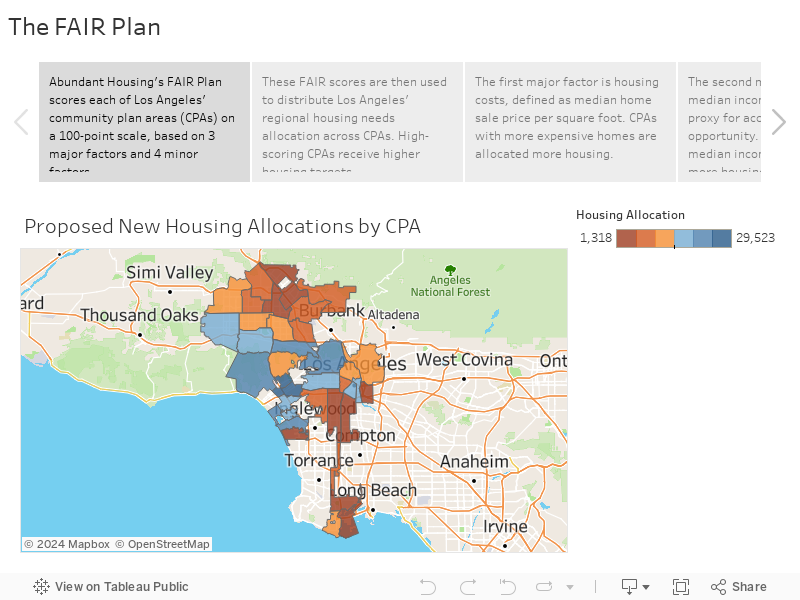
Under this methodology, each of Los Angeles' community plan areas (CPAs) is scored on a 100-point scale, based on 3 major factors and 4 minor factors. CPAs with higher FAIR scores are allocated a higher share of the city’s housing target. The dashboard of interactive maps below provides more detail on how each CPA scores under the FAIR Plan (you can also take a closer look here).