

Policy and Research
A Pro-Housing Policy Agenda for LA
For decades, we haven’t built enough homes to meet our needs. This has caused home prices and rents to skyrocket, creating financial pressure on households and putting homeownership out of reach. Some families have responded by moving to exurban areas, enduring long commutes and worsening carbon emissions. Others have left Southern California altogether, including many lower-income households and communities of color. Worst of all, over 66,000 of our neighbors have become homeless across L.A. County.
More homes in urban centers, near transit and jobs, support low-carbon living and give people an alternative to car dependency. More homes in exclusionary neighborhoods will break down barriers and ensure that Black, Latino, and Asian Americans are no longer excluded from housing opportunities and no longer experience displacement.
We can’t wait any longer to fix the housing crisis.
More homes benefit all Angelenos, through lower rents, greater access to jobs and good schools, less car dependence, and a stronger economy. But more homes also address the many other challenges we face today.
The Core Four
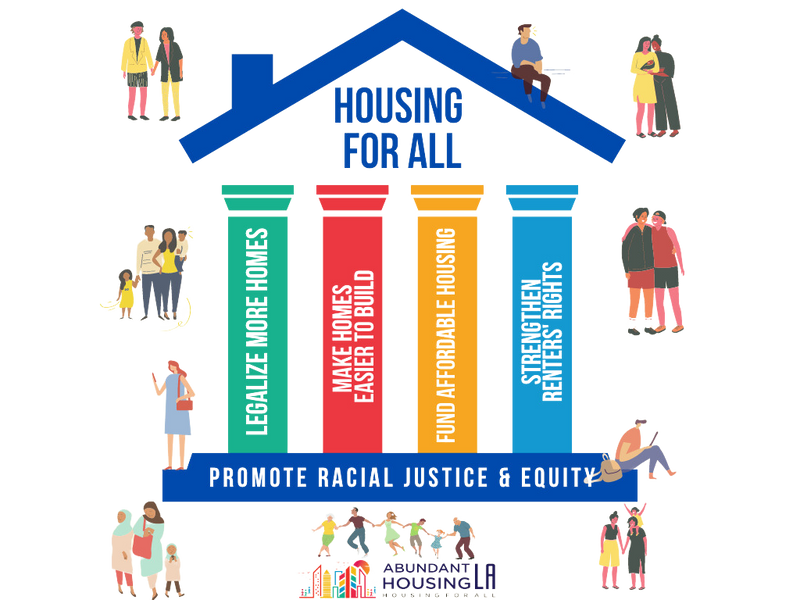
The Core Four are like columns that support a house. All four need to be strong for the house to stand. The house also needs a solid foundation; in our case, the foundation is the goal of promoting racial justice and equity.
Similarly, while cities should adopt as many pro-housing reforms as possible, it is also important to implement some policies from each of the four categories, in order to solve the housing crisis while promoting racial justice and equity.
-
The Los Angeles region’s cities and neighborhoods are defined by exclusion. Exclusionary zoning bans duplexes, apartments, and subsidized affordable housing in most “residential” areas. This makes housing more expensive, maintains patterns of racial and class segregation, and fuels neighborhood displacement by shifting housing demand to lower-income areas. We want to end exclusionary zoning and apartment bans, especially in wealthy, high-opportunity neighborhoods.
AHLA offers a blueprint for how the City of Los Angeles can encourage more apartments citywide:
Allow multifamily homes in all commercially zoned areas, near job centers, and near transit, especially in high-income areas.
Embrace ambitious housing growth targets throughout the Los Angeles region, and fairly distribute new housing capacity across neighborhoods.
Create more housing for lower-income households in high-income neighborhoods.
Implement pro-housing, holistic anti-displacement policies that apply citywide alongside ending exclusionary zoning and increasing new housing production.
-
Complex administrative and political approval processes make it difficult, time-consuming and expensive to build housing. This discourages home building and adds to the cost of housing, and also creates opportunities for “pay-to-play” situations and outright corruption. Wealthy homeowners frequently use their political influence to block housing, including affordable and permanent supportive housing, through this flawed approval process.
Make most residential and mixed-use developments “by-right.
Expedite approval of deed-restricted affordable and permanent supportive housing.
Take action on climate change by reforming the California Environmental Quality Act (CEQA).
Remove barriers to housing at the ballot box.
Improve public outreach methods for decision-making on housing.
-
Los Angeles County has a deficit of over 700,000 homes that are affordable to households with low incomes, a situation that accelerates neighborhood displacement and pushes Angelenos into homelessness. Addressing this significant need requires $100 billion annually in new local, state, and federal funding for the production and preservation of enough affordable homes to meet cities’ below-market-rate housing growth targets under the Regional Housing Needs Assessment. New affordable housing should be situated throughout a city’s neighborhoods, both in high-cost, high-opportunity areas, as well as in disadvantaged neighborhoods where public investment has been insufficient and displacement risk is high.
Make rent subsidies available to all lower-income households.
Fight displacement by helping tenants buy their homes.
Reform Proposition 13 and tax property owners fairly.
Produce housing on city and county owned land.
Introduce taxes on vacant homes and lots, demolition of existing housing units, and on home-sharing/short-term rentals.
-
Housing scarcity is particularly harmful to lower-income renters, who are frequently at risk of fast-rising rents and eviction. In addition to building and funding more homes, Los Angeles must actively enforce and expand renters’ legal rights, to ensure that renters can access stable, affordable homes and to prevent neighborhood displacement in lower-income communities.
Increase compensation and support for tenants that are displaced by redevelopment. Before a rental unit can be taken off the market for redevelopment, the property owners should have to provide tenant compensation far beyond existing law. This would include a “right of return” after redevelopment, at the same rent as before, and rental assistance during redevelopment. Tenants should also have the option to negotiate a fair, voluntary buyout agreement in lieu of a right to return.
Provide free legal counsel to all renters. This will reduce evictions by ensuring that tenants are well-represented in housing court, and encourage landlords to settle disputes with tenants without taking legal action.
Limit evictions to “just cause” scenarios, like nonpayment of rent or property destruction. This prevents landlords from using sudden, sharp rent increases to push out tenants.
Create a citywide streamlined application and notification system for affordable housing units. The current process is burdensome; information about new affordable units is difficult to find, and there’s no clear process for applying for these units. A simple notification and application system will expand access to new affordable housing.
Create a comprehensive online registry of all rental properties. This will make it much easier for cities to communicate information to tenants and landlords, and to proactively enforce tenants’ rights laws.
Track and prosecute slumlords who repeatedly violate housing codes and tenant rights. By tracking and prosecuting repeat offenders, cities can encourage better housing conditions and bar the worst slumlords from owning and managing apartments.
Policies in this category include AB 1482 (anti-rent gouging), SB 329 (landlords can’t refuse Section 8 voucher holders), and SB 330 (requires one-for-one replacement of demolished rent-controlled units).
Policy Tracker
-
-
-
Sponsor:AB 1335 (Zbur) – Strengthening Sustainable Communities Strategies – February 23, 2023
AB 2667 (Santiago) – Affirmatively Furthering Fair Housing – April 17, 2024
Support:
AB 7 (Friedman) – Transportation: planning: project selection processes – June 22, 2023
ACA 10 (Haney) – Right to housing – March 9, 2023
AB 1287 (Alvarez) – Strengthening density bonus law – March 14, 2023
AB 1820 (Schiavo) – Housing development projects: applications: fees and exactions. – April 18, 2024
AB 2243 (Wicks) – AB 2011 Clarification and Expansion – April 9, 2024
AB 2498 (Zbur) – California Housing Subsidy Act – May 10, 2024
AB 2560 (Alvarez) – Density Bonus Law: California Coastal Act of 1976. – April 12, 2024
AB 2580 (Wicks) – Historic Designation Annual Reporting – April 3, 2024
AB 2909 (Santiago) – Mills Act Program, Adaptive Reuse – April 3, 2024
AB 2996 (Alvarez) – California FAIR Plan Association — April 17, 2024
AB 3012 – (Grayson) Housing Data: Impact Fees — April 17, 2024
AB 3068 (Haney) – Adaptive reuse: streamlining: incentives — April 10, 2024
AB 3093 (Ward) – Planning for acutely low-income housing – June 10, 2024
AB 3122 (Kalra) – Streamlined Housing Approvals: Objective Planning Standards — April 10, 2024
AB 3177 (W. Carrillo) – Mitigation Fee Act: land dedications: mitigating vehicular traffic impacts – April 26, 2024
SB 7 (Blakespear) – Homeless Housing Obligation Act – May 18, 2023
SB 450 (Atkins) Housing development: approvals – June 8, 2023
SB 937 (Wiener) – Fee Deferral and Entitlement Extension – June 7, 2024
SB 951(Wiener) – Coastal Zone Reform – April 23, 2024
SB 1077 (Blakespear) – ADUs in the CoastalL Zone – March 31, 2024
SB 1123 (Caballero) – Planning and zoning: subdivisions: ministerial review – May 16, 2024
SB 1193 (Menjivar) – Banning Leaded Airplane Fuel – April 3, 2024
SB 1211 (Skinner) – Optimizing Multifamily ADUs – March 12, 2024
SB 1462 (Glazer) Subdivisions: disbursements of deposits – April 8, 2024
SB 1470 (Glazer) Construction defect cases – April 17, 2024
AB 2140 (J. Carrillo) Building Homeownership Act – March 12, 2024
AB 2144 (Grayson) General Plan: Annual Report, Housing Data March – 13, 2024
SB 2553 (Glazer) Subdivisions: disbursements of deposits – April 8, 2024
Oppose:
SB 1011 (Jones) Encampments: penalties – April 2, 2024
SB 1055 (Min) ADUs & RHNA – March 12, 2024
SB 968 (Seyrato) Planning and zoning: regional housing needs allocation – March 12, 2024
SB 986 (Seyarto) Ballot label: bond measure fiscal impact – March 13, 2024
Comments:
Governor’s January Budget Proposal for FY 2024-2025 – January, 26, 2024
-
Sponsor:
AB 1335 (Zbur) – Strengthening Sustainable Communities Strategies – February 23, 2023
Support:
AB 68 (Ward) – Facilitating infill development and protecting rural areas – March 21, 2023
AB 309 (Lee) – The Social Housing Act – May 5, 2023
AB 835 (Lee) – Single stair reform – February 27, 2023
AB 976 (Ting) – Accessory Dwelling Units: Owner-Occupancy – July 3, 2023
AB 1317 (W. Carrillo) – Unbundled parking – March 15, 2023
AB 1607 (W. Carrilo) – Los Angeles County Affordable Housing Solutions Agency – July 6, 2023
AB 1633 (Ting) – Housing Accountability Act: Disapprovals: CEQA – August 22, 2023
SB 567 (Durazo) – Homelessness Prevention Act – April 25, 2023
Oppose:
SB 31 (Jones) – Prohibitions on encampments – December 14, 2022
Comments:
Governor’s January Budget Proposal for FY 2023-2024 – January 13, 2023
Local Position Letters
-
2023-02-27 – Support for Governance Reform Motion – File # 23-0683
2022-10-17 – Multifamily Residential Parking Requirements
2022-07-08 – 2045 Climate Action Plan
2022-06-27 – Expanding the Office of Diversion and Re-Entry
2022-01-24 – Los Angeles County Tenant Protections
2022-10-31 – Comments on Manhattan Beach Housing Element
2022-09-19 – Support for Measure H (Rent Control & Just Cause Eviction Protections)
Research